 3Davis
Open-world UC Davis campus
Playable in the browser. No install, no account.
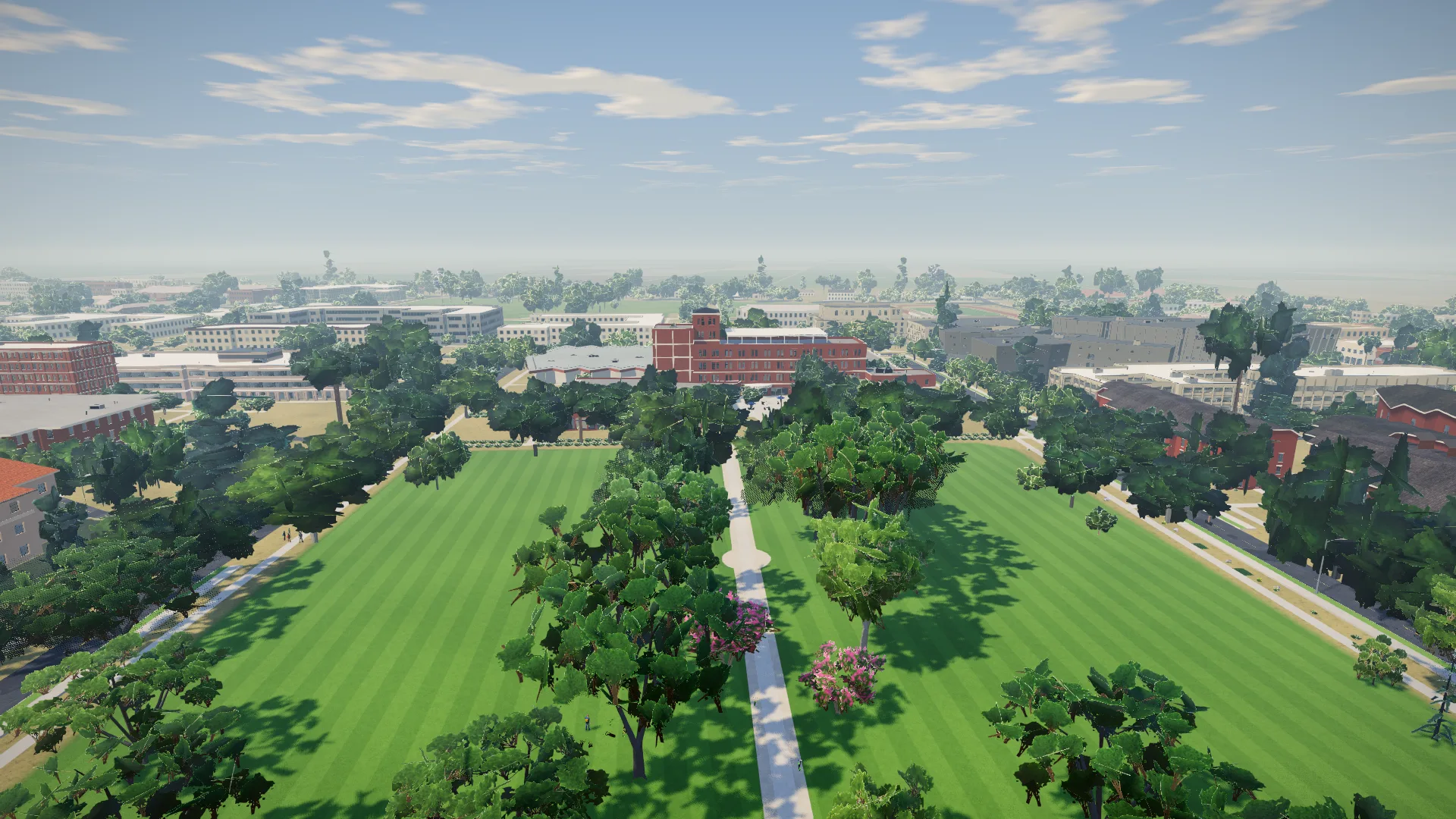
3Davis is the UC Davis campus as an open world you can play in a browser: the Quad, the Silo, Shields Library and the Arboretum, built from open map data and filled with students who have names, schedules and memories.
The idea was to enclose the campus in a virtual space, so Davis can come with you wherever you go, and to play on a map full of fun, familiar references.
- Client
- Independent project
- Role
- Designer and creative director, built with AI coding agents
- Timeline
- September 2026 to present
- Stack
- TypeScript · Three.js · Rapier physics · React
- Data
- OpenStreetMap · USGS lidar · USDA aerial imagery
Davis, wherever you go
A campus is a place people carry with them long after they leave it. I wanted to enclose UC Davis in a virtual space, so the Quad, the bike paths and the Silo could come along anywhere, and to turn that space into a map to play on.
The fun comes from references any Aggie recognizes: burritos at the Silo, the London double-decker buses, the Bookhead egghead in front of Shields, the horses at the equine center. 3Davis is part tribute and part sandbox, a real place where you can do things the real place would never let you.
Who it's for
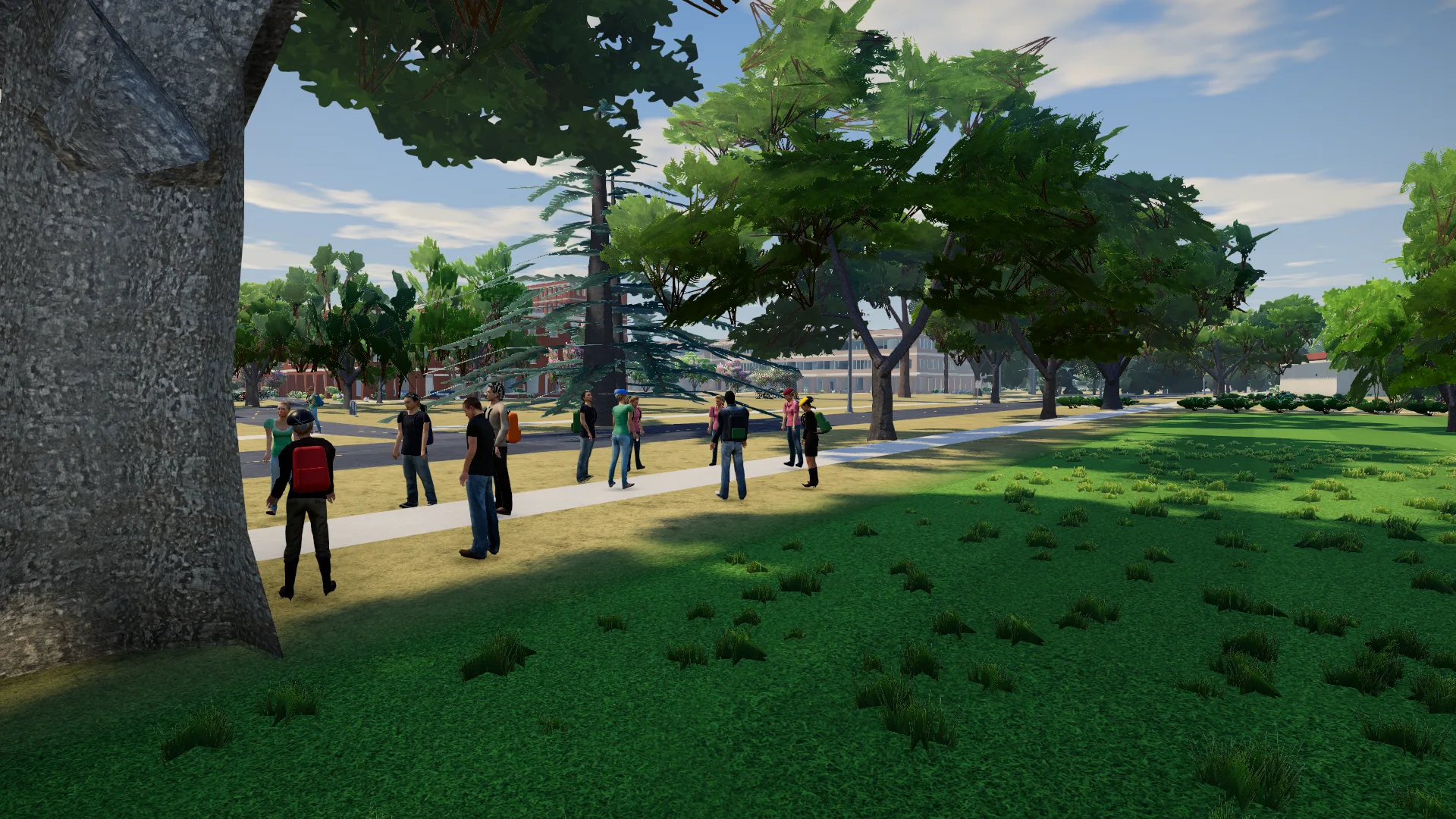
3Davis is designed for four groups. They want different things from the same map, so the world had to work as a guide, a memory and a game at once.
Learn the campus by playing it: find a building, ride the bus, race a friend to class, meet people around the Quad.
Walk the Quad again from anywhere, with the places and running jokes they remember.
Explore Davis before visiting, with real buildings, real distances and real streets.
A GTA-style sandbox where the map is a real place you can recognize.
Design principles
From blocks to a living campus
I directed the project as a creative director working with AI coding agents. Each agent had one job, in stages: a Look Director first, then NPC, Buildings, Streets and Vegetation agents working from one shared material library. My role was to set the direction, playtest constantly and decide what felt right.
- Sep 26, 2026Voxel prototype
The structure worked but the blocky look was far too plain. The direction changed to a GTA V-style world with much more detail.
- Sep 27Open-world rules
No instant vehicle switching: you walk to a bike, rent a scooter, and earn money in campus jobs at the Coffee House, Shields Library, the Bike Barn and a courier route.
- Sep 27Open data only
Heights, roofs and trees come from public-domain USGS lidar and USDA aerial imagery. Google imagery is off limits by its terms of service.
- Sep 28Named 3Davis
The game gets its name and its horse logo.
- Oct 8Real human motion
Motion-capture walk and run cycles, realistic speeds, and a missions leaderboard.
- OctoberStory missions
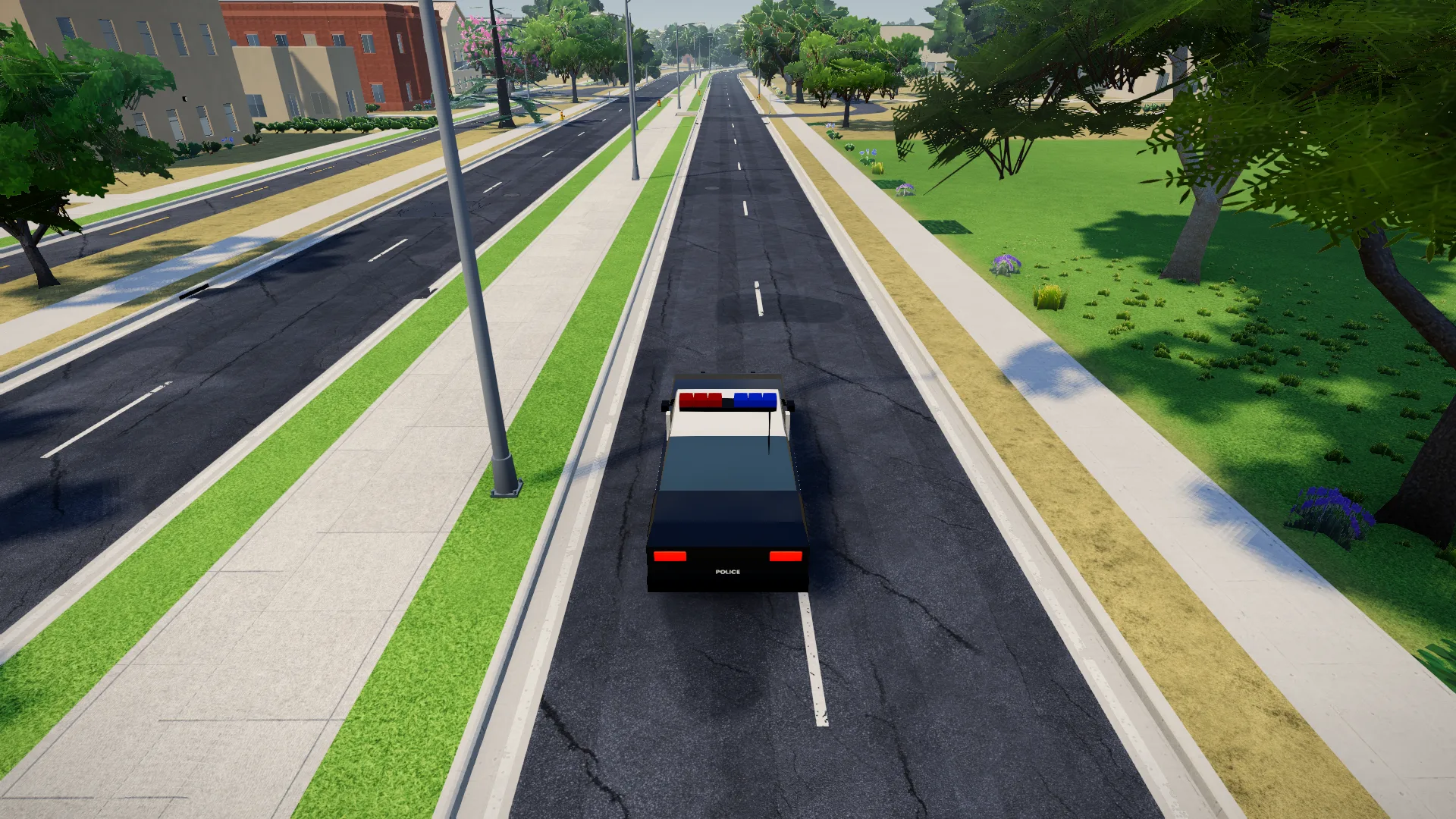
Save Cheeto, a chase with a campus police car, and the Aggie Derby, a horse race across campus.
- Oct 24 to 26Realism pass
Realistic avatars, a physics overhaul, a mission board with GPS, the Silo Terminal and its double-deckers, and a long list of playtest fixes.
A real campus, from open data
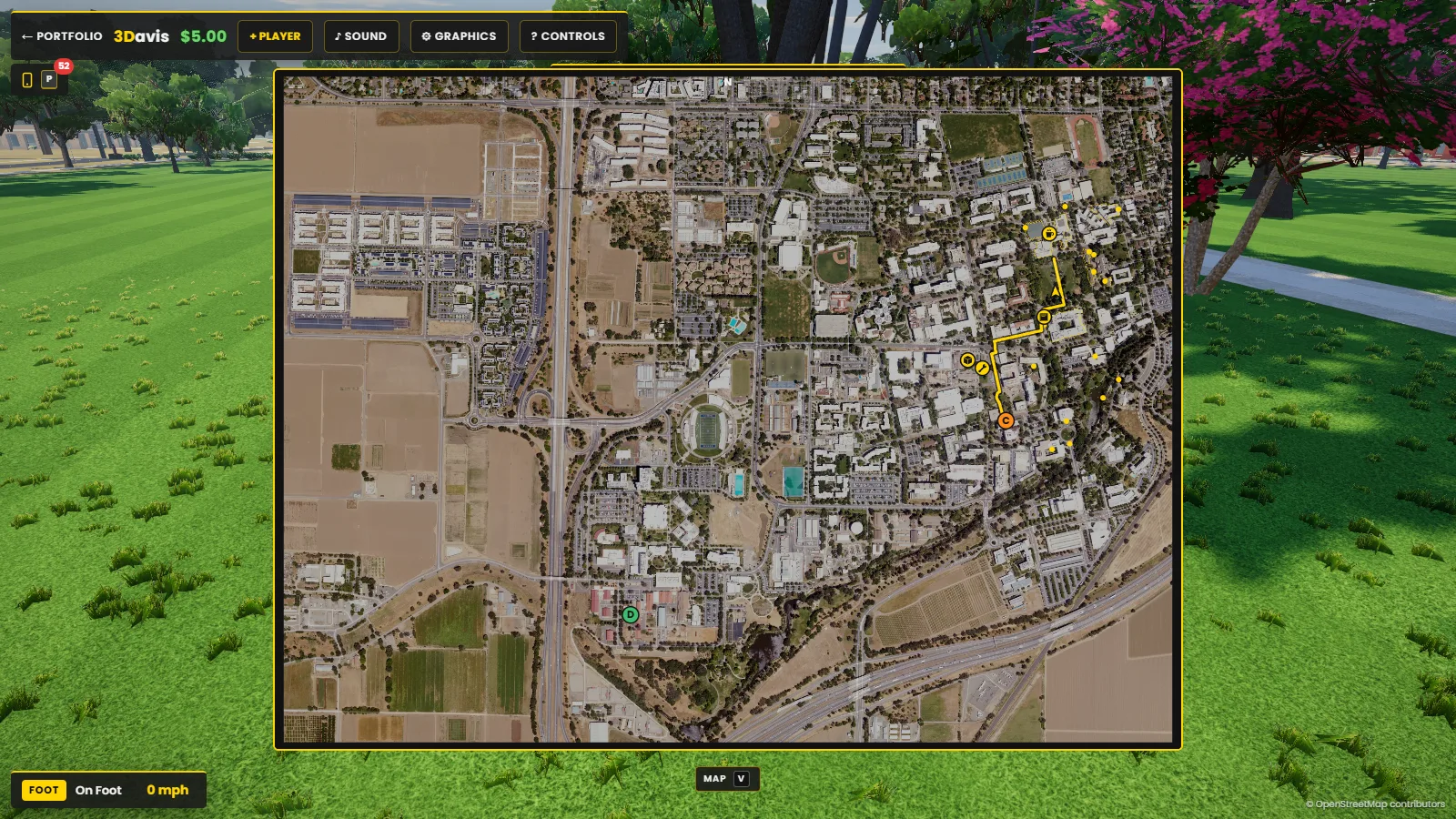
The whole campus, about 2 by 1.2 miles, is built from open sources: OpenStreetMap for footprints and streets, USGS lidar for heights and tree canopy, and USDA aerial imagery for roofs and vegetation. No Google Maps or Street View imagery, whose terms do not allow deriving content from it.
OpenStreetMap footprints with heights from lidar. 58 landmarks have facades researched from public photos and official UC Davis pages.
Each tree placed, sized and shaped from USGS 3DEP lidar canopy heights and USDA NAIP vegetation imagery.
Lawns, fields, gardens, parking lots and water, each drawn with its own material.
References Aggies recognize
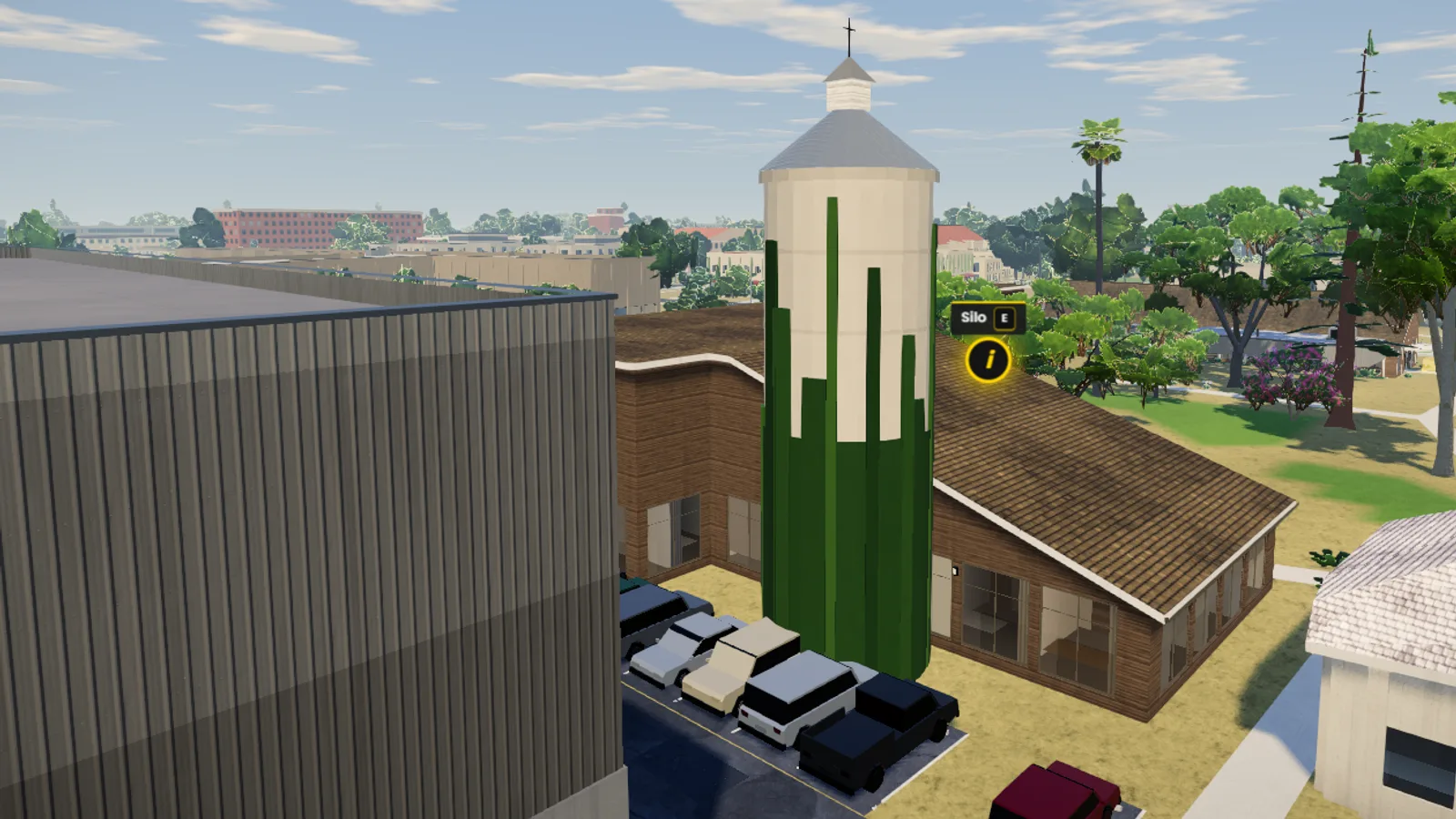
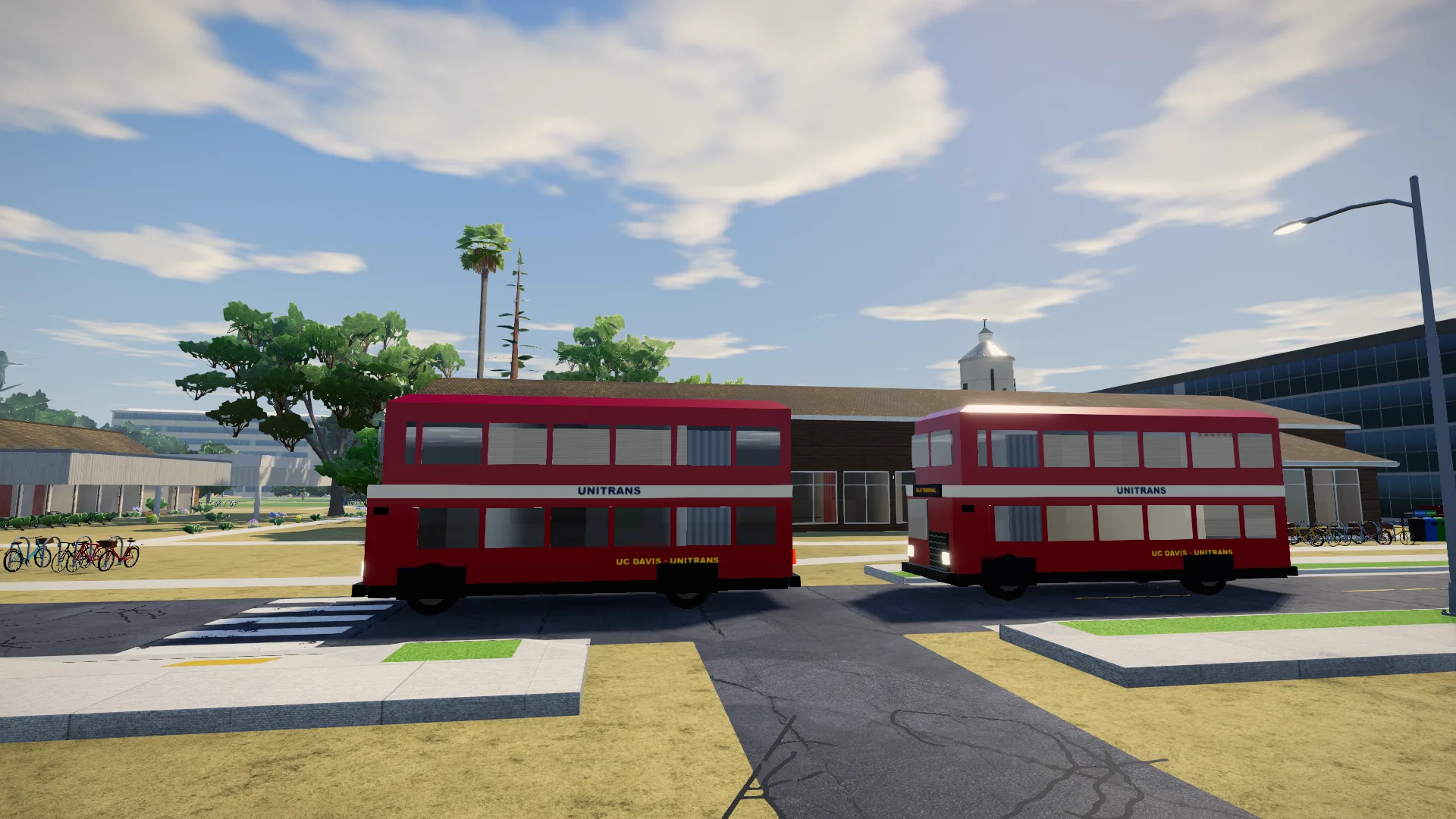
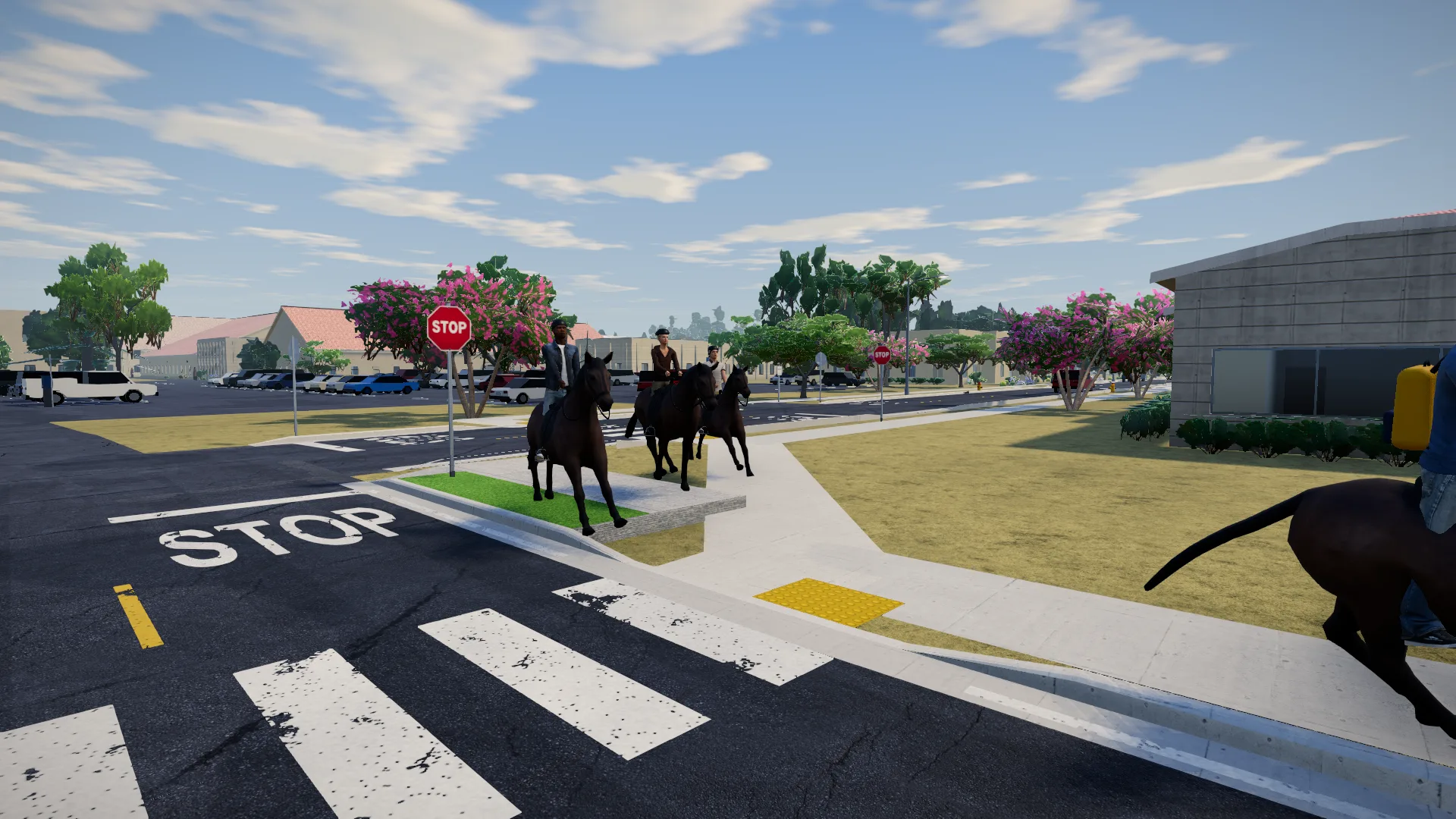
Missions and set pieces come from the campus itself. Unitrans's red double-deckers wait at the Silo Terminal with their doors cycling open and shut, and if you walk up while one is open, you can drive off with it. The Aggie Derby starts at the Vet Med equine center and races across campus to the Quad.
A campus that remembers you
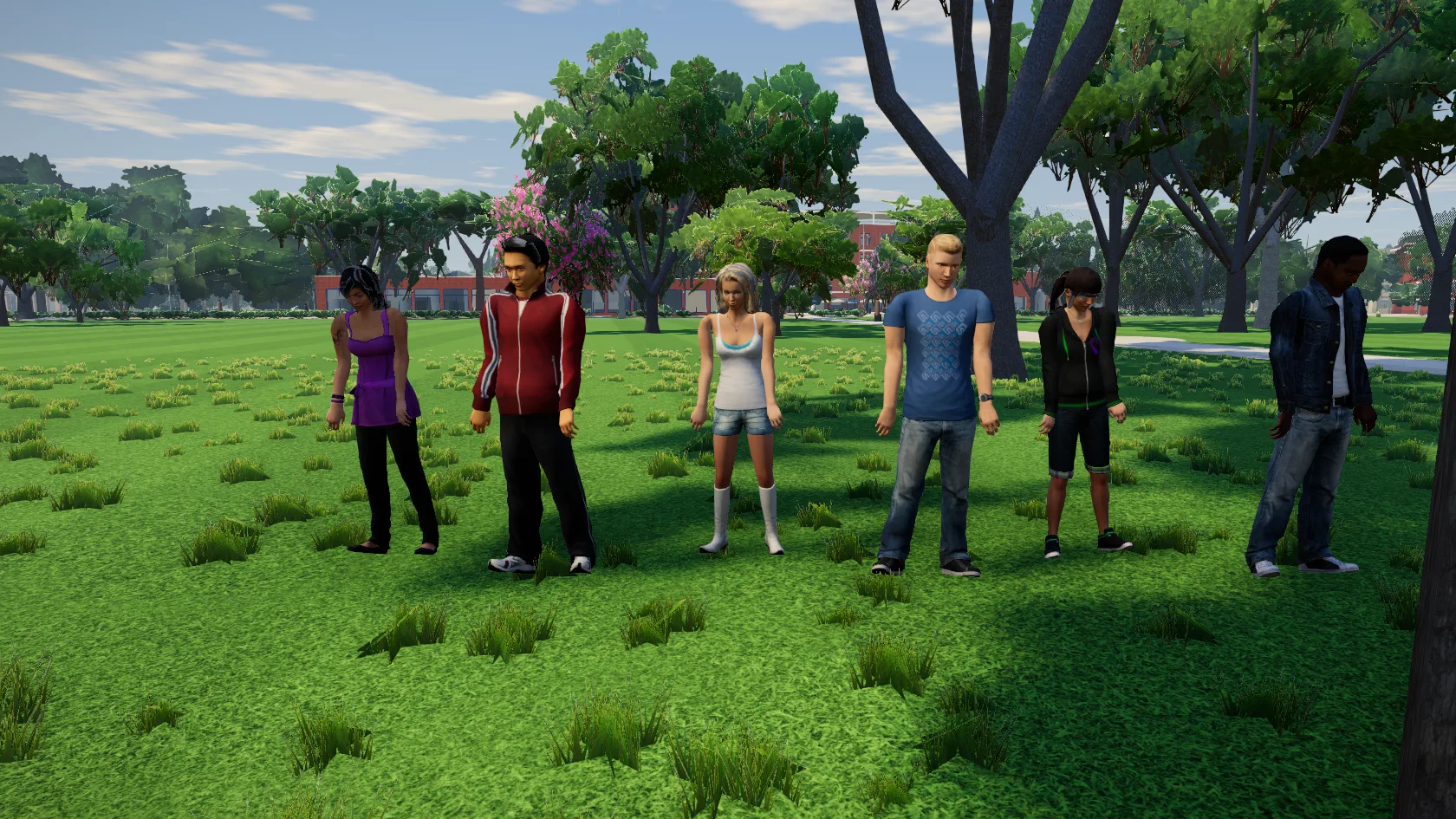
The same 390 people live on campus every session, each with a role, a personality, a look and a daily schedule of real buildings. About 124 of them are simulated around you at any moment, walking, cycling and riding scooters to their next class.
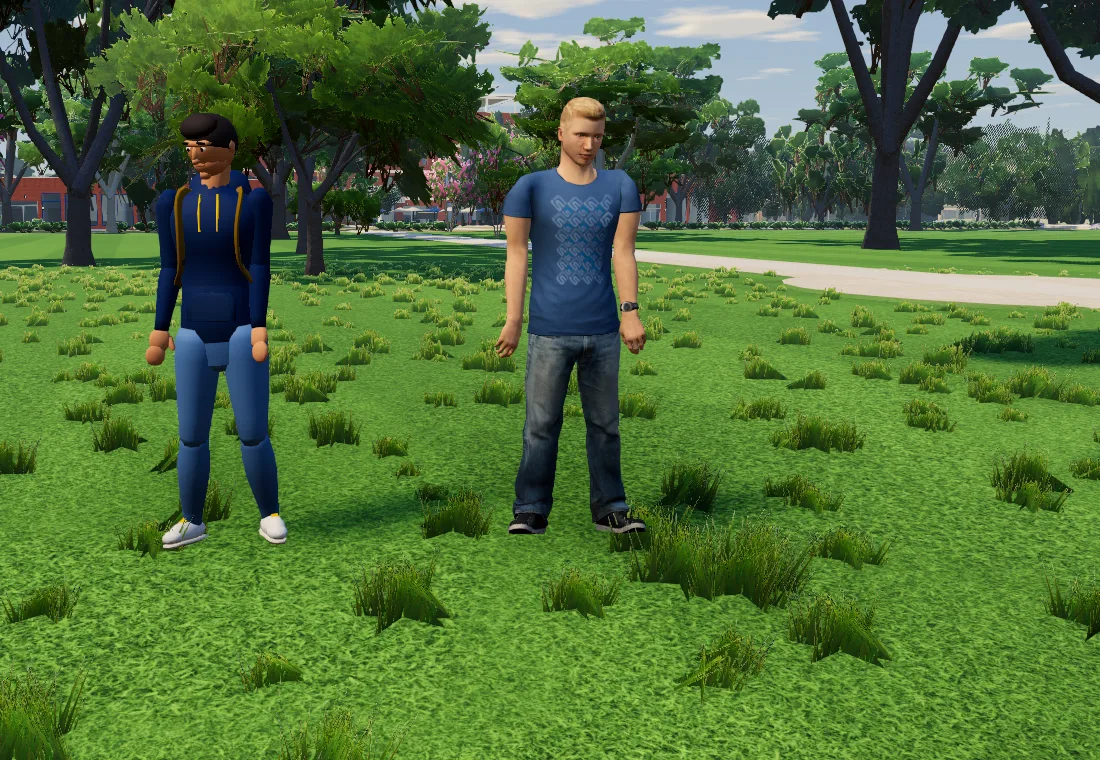
The NPCs went through four versions, each one driven by what felt wrong in the previous one.
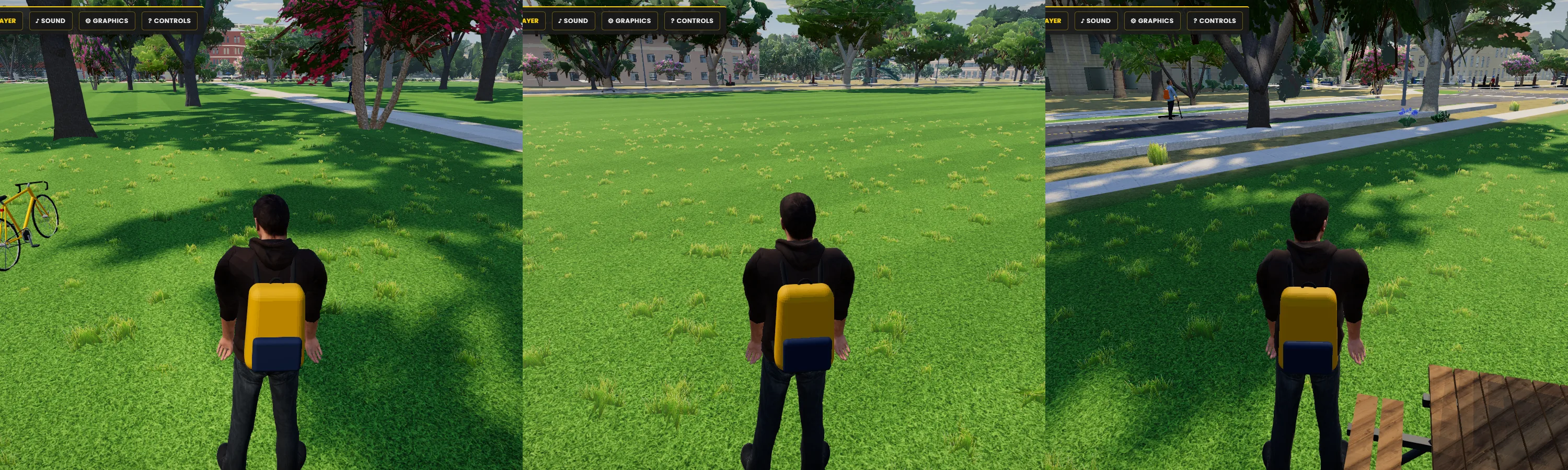
From sticks to people
The same pose, before and after. The animation rig stayed. A realistic avatar is fitted onto it every frame, so everything learned about motion carried over.
Fixing what felt wrong
I playtested every build and wrote down what felt off, in plain words. Each note became a measurable problem: find the cause, fix it, then measure it in the running game rather than trusting a screenshot.
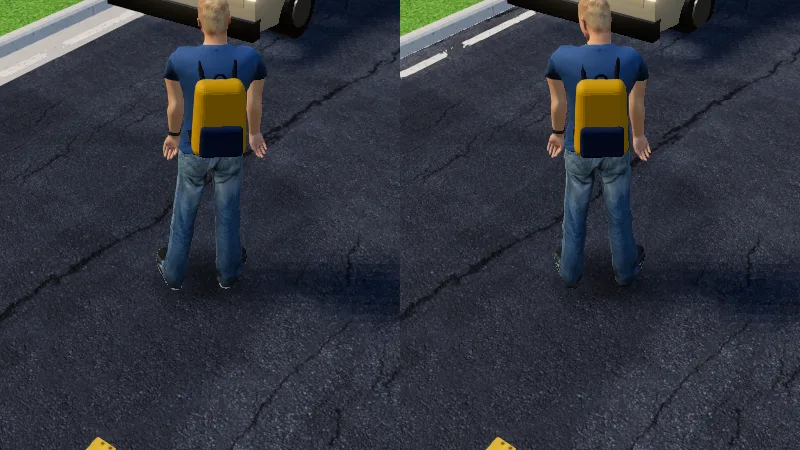
The buried-shoes bug
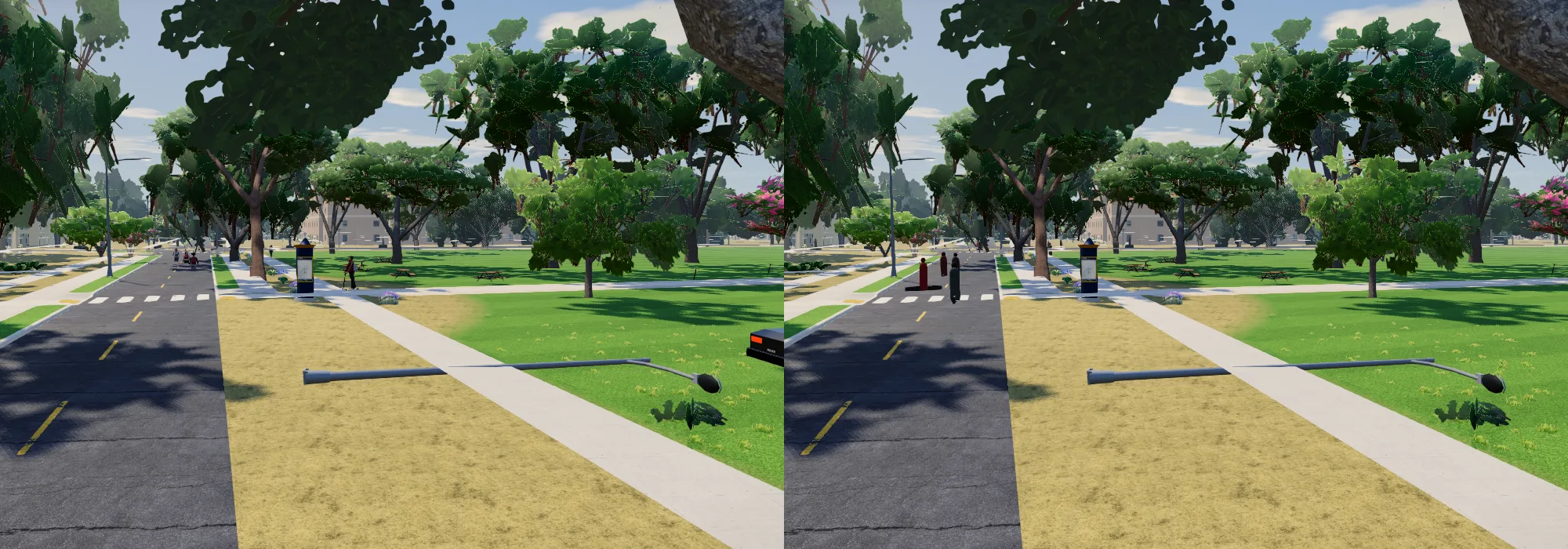
Everything measured as standing exactly on the ground, yet looked sunk into it. The road was being drawn a few centimeters "in front" of the camera to stop ground layers from flickering. Seen from head height, that was enough to paint over shoes and tires.
Left: fixed. Right: the original setting, same frame.
An interface that gets out of the way
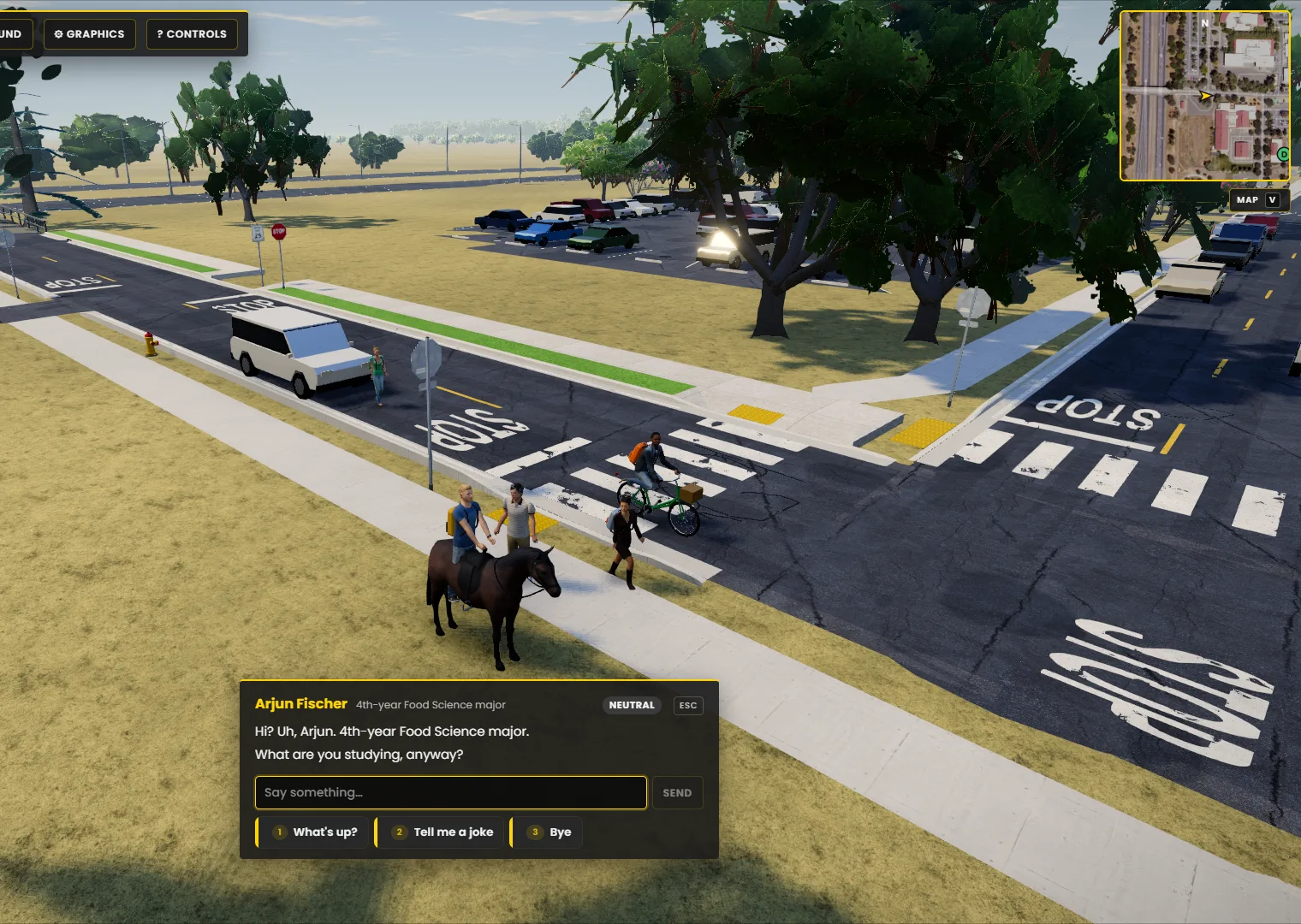
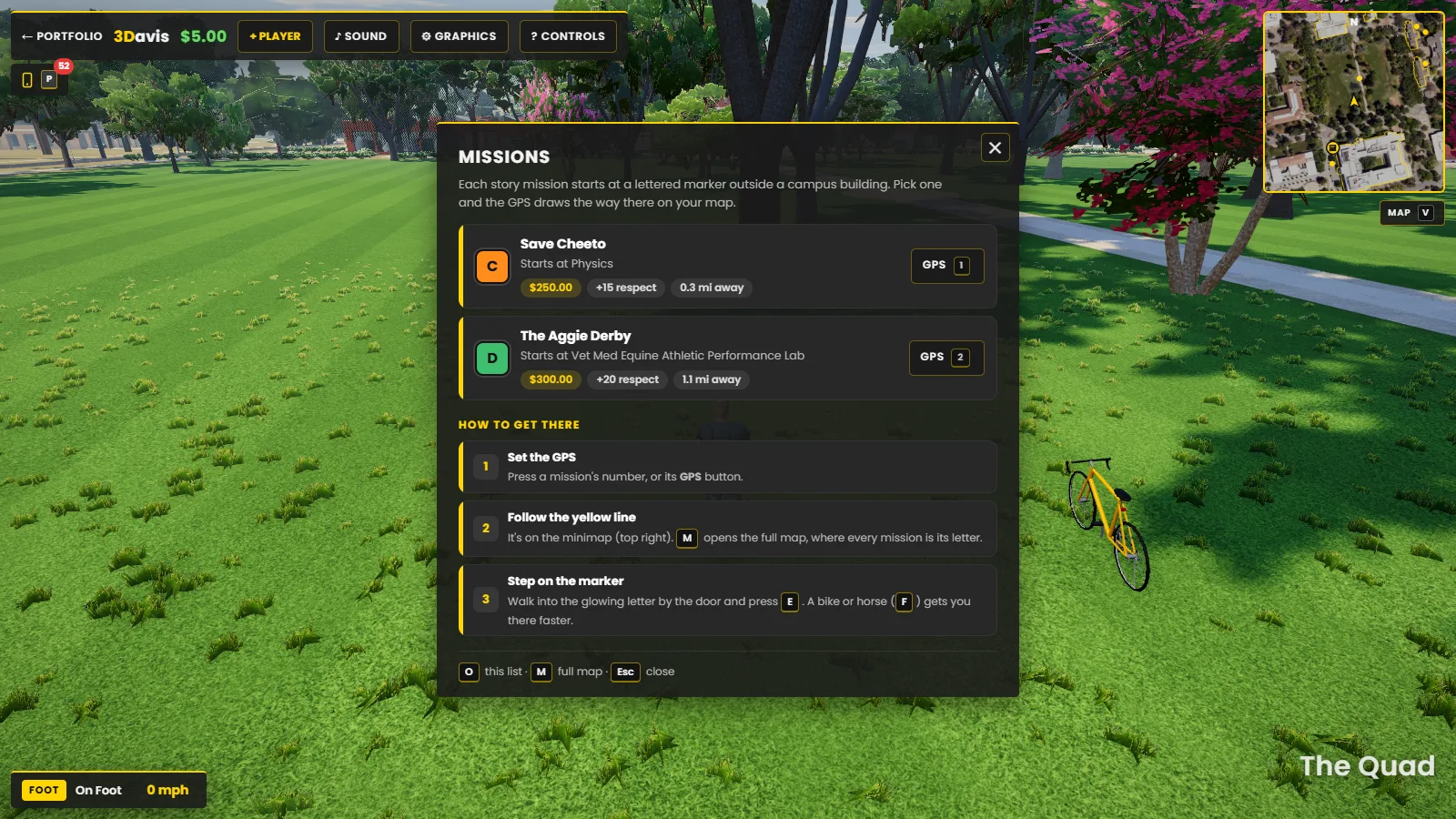
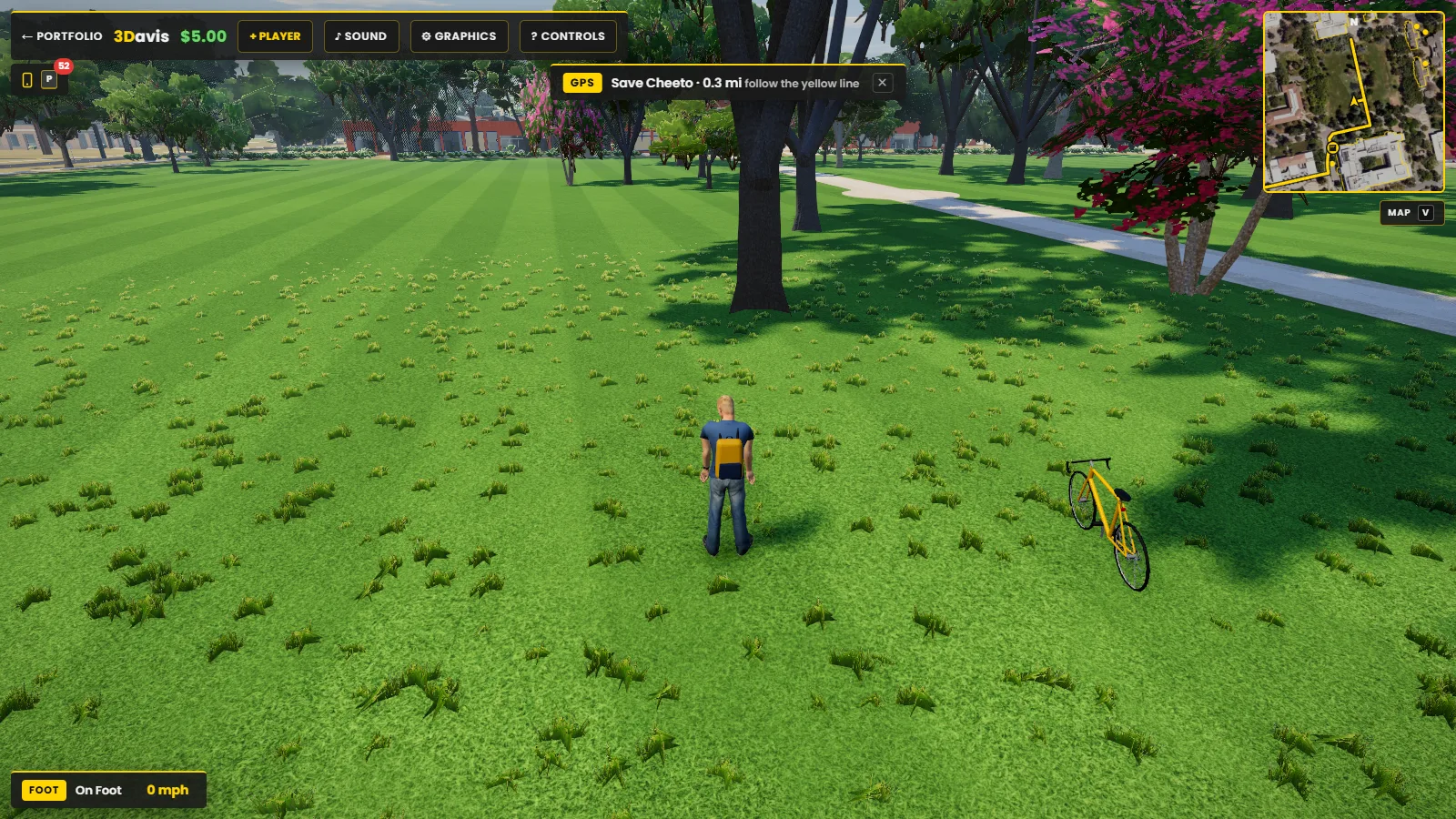
The HUD follows the GTA tradition: charcoal panels, one strong yellow accent and Poppins throughout. Lists use one tile component, a dark rounded card with a thick yellow bar, an icon, a bold label and pill tags, from the controls panel to the mission board.
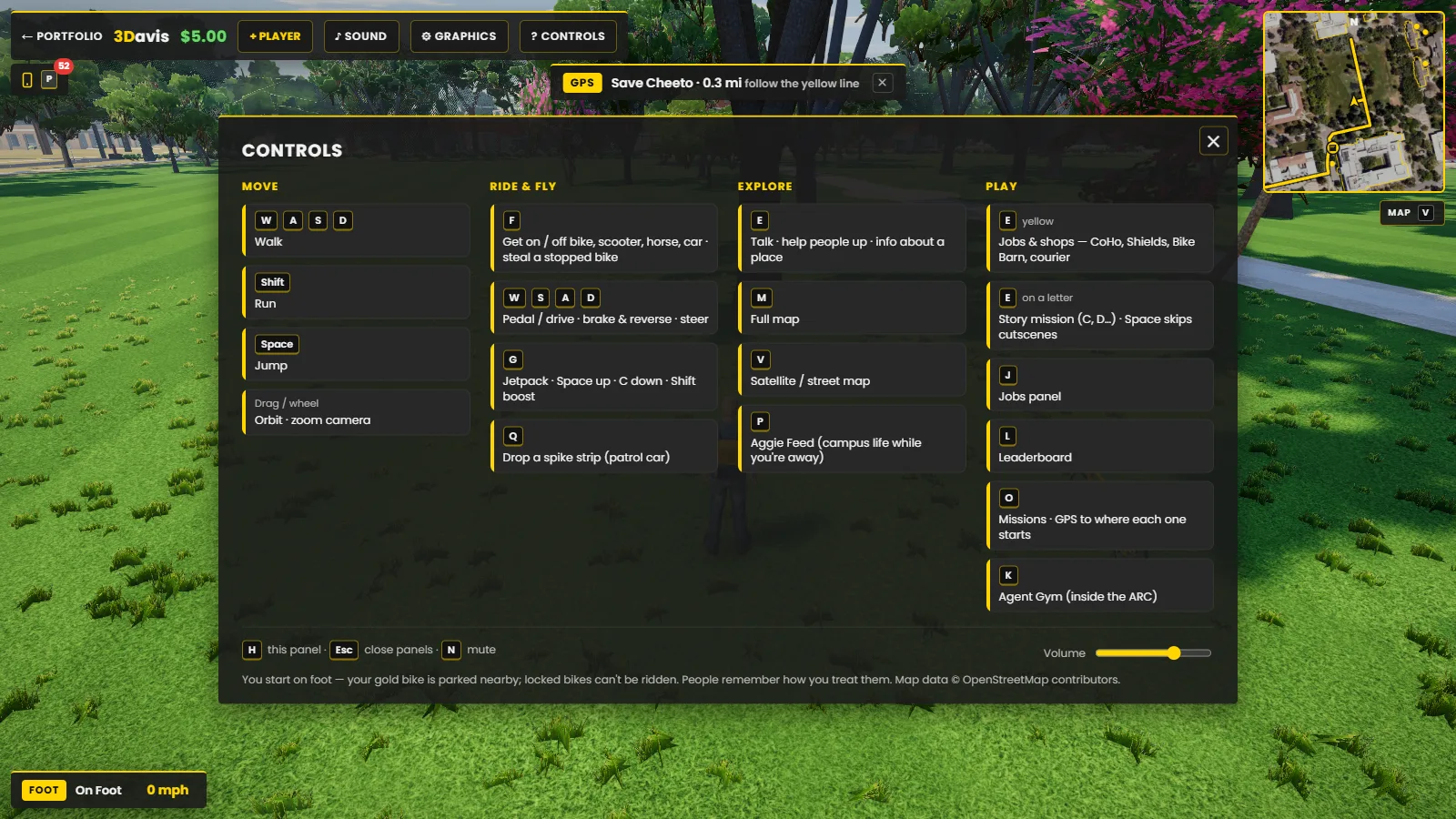
#022851Brand#FFBF00Brand#FFD500Interface#1A1A1APanelsBikes, rented scooters, horses, the patrol car, a jetpack and the Unitrans double-deckers, each with its own handling.
A mission board opens after the controls. Pick one and the GPS draws the route on the minimap and the full map.
Earn money at the Coffee House, Shields Library, the Bike Barn and on courier runs, with a leaderboard.
Thin poles fold when you hit them and thick ones stop you. Cars cannot drive into water.
Press E next to someone. They answer from their schedule, their memory of you and real campus geography.
Miles, feet and mph throughout, like the place it represents.
Under the hood
Three.js renders the world with ambient occlusion, bloom and ACES tone mapping. Rapier handles physics, and an automatic quality ladder keeps the frame rate up while sun shadows always stay on. Buildings, props and people are batched and instanced, so the whole campus draws in about 150 calls.
On a laptop with an integrated AMD 780M GPU, the game holds 60 to 80 FPS with more than a hundred people around you.
Where it's headed
The next step is detail that grows outward from the Quad, building by building, so the most familiar places look closest to the real ones. More missions built on campus references are planned, along with streets that feel even more lived in.
Data and asset sources
- OpenStreetMap contributors (ODbL): buildings, streets, paths, land use
- USGS 3D Elevation Program lidar (public domain): heights and tree canopy
- USDA NAIP aerial imagery (public domain): roofs, vegetation, satellite minimap
- Microsoft Rocketbox avatar library (MIT): people and horses
- Carnegie Mellon Graphics Lab Motion Capture Database: walk and run cycles